
Ancestral Remembrance, Inner Shakti And The Sacred Season Of Descent

There comes a point in autumn when the season seems to turn inward. The generous light of summer has receded, the leaves are loosening their hold, and the evenings begin to gather around us earlier. What was vivid and outward-facing starts to soften. The earth does not resist this movement. She releases, withdraws and draws her energy down towards the roots.
For many of us, descent can feel less natural. We have been taught to associate light with clarity, growth and goodness, while darkness is often treated as something to overcome. We may feel more comfortable with beginnings than endings, with becoming than unbecoming, and with answers rather than the fertile uncertainty that comes before them.
Yet the dark is not simply an absence of light. It is the womb, the seed beneath the soil, the quiet place in which new life gathers before it can be seen. It is rest, mystery, gestation and the unseen work of transformation. The dark asks us to listen differently.
I have always been drawn to the rhythms of nature and to the deeper meaning held within the turning of the seasons. During the years I spent living in India, this sensitivity was deepened through my relationship with Vedic wisdom and its understanding of life as part of a greater cosmic rhythm. I have also long felt a connection with the earth-based traditions of these lands, in which the changing seasons were recognised not only as movements in nature, but as sacred passages within human life.
At this time of year, several ancient traditions speak to me with particular depth. Pitru Paksha invites remembrance of those who came before us. Navaratri honours the Divine Mother and the many expressions of Shakti, the sacred power that creates, protects, nourishes and transforms. Later in the month, Samhain marks the movement into the darker half of the year and carries its own traditions of ancestral remembrance.
These observances arise from different cultures and spiritual lineages, each with its own history and sacred meaning. I do not see them as interchangeable, yet I am deeply moved by the threads that seem to run between them: remembrance, reverence for the unseen, the mystery of transformation and an understanding that darkness is not separate from life, but an essential part of its rhythm.
The Ancient Call to Remember
Within the wider Vedic tradition, Pitru Paksha is a sacred period devoted to remembering and honouring the ancestors. Through prayer, offerings and acts of gratitude, the living acknowledge those whose lives made their own possible. The practices vary between families, regions and lineages, but the heart of the observance is remembrance: a recognition that none of us begins with ourselves.
There is humility in this acknowledgement. Our lives do not stand alone. We are part of a continuum shaped by people whose choices, sacrifices, struggles and love helped create the conditions in which we now live. Some are known to us through names, faces and stories. Others have disappeared from family memory, yet their lives remain woven into our own existence.
A similar call to remembrance appears later in the Celtic seasonal calendar. Samhain marks the end of the harvest and the movement from the lighter half of the year into the darker half. Traditionally associated with ancestors and the unseen, it recognises a time when ordinary boundaries were understood to become more permeable and the departed were remembered alongside the living.
Pitru Paksha and Samhain belong to different cultures and should not be treated as versions of the same observance. Yet I find their shared symbolism deeply moving. As the natural world withdraws and darkness grows, human attention also turns towards what cannot be seen: the lives behind our lives, the mystery of death and continuity, and the bonds of belonging that reach beyond the visible world.
Both remind us that remembrance is not simply looking backwards. It is an act of relationship. In remembering where we come from, we may understand more fully what is living through us now.
What Lives Through Us
We carry many visible inheritances – a family name, features, stories, recipes, customs and ways of speaking. We also carry less visible ones. Patterns of strength and survival. Beliefs about love, work, safety, belonging and worth. Grief that was never fully expressed. Gifts that may have travelled through generations before finding a place to flower in us.
Ancestral presence does not always arrive as a clear memory. It may be felt in an instinctive love of the land, a familiar gesture, a phrase spoken in the voice of a parent or grandparent, or a resilience whose origins we cannot quite explain. At times it may appear through repeating family patterns or through emotions that seem older than the immediate moment. Whether understood spiritually, psychologically or symbolically, our relationship with ancestry can offer a deeper context for who we are.
To honour our ancestors is not to idealise the past or deny its pain. Family histories can be complex. Some people inherit a strong sense of belonging; others inherit silence, rupture or experiences that remain difficult to hold. Some know their ancestral stories in detail, while others have little access to them. Remembrance can therefore take many forms. It may be gratitude. It may be grief. It may be a compassionate acknowledgement of all that was carried, endured or left unfinished.
We can honour what gave us life without believing that every inherited pattern must define us.
Conscious awareness changes our relationship with what we inherit. It allows us to recognise the gifts that seek expression through us, while bringing compassion and choice to the places where pain has repeated itself. Healing does not erase the past. It changes the way the past continues to live within the present.
This may be one of the most loving ways to tend an ancestral line: not by pretending that everything within it was whole, but by meeting what has reached us with honesty, reverence and awareness.
Awakening the Shakti Within
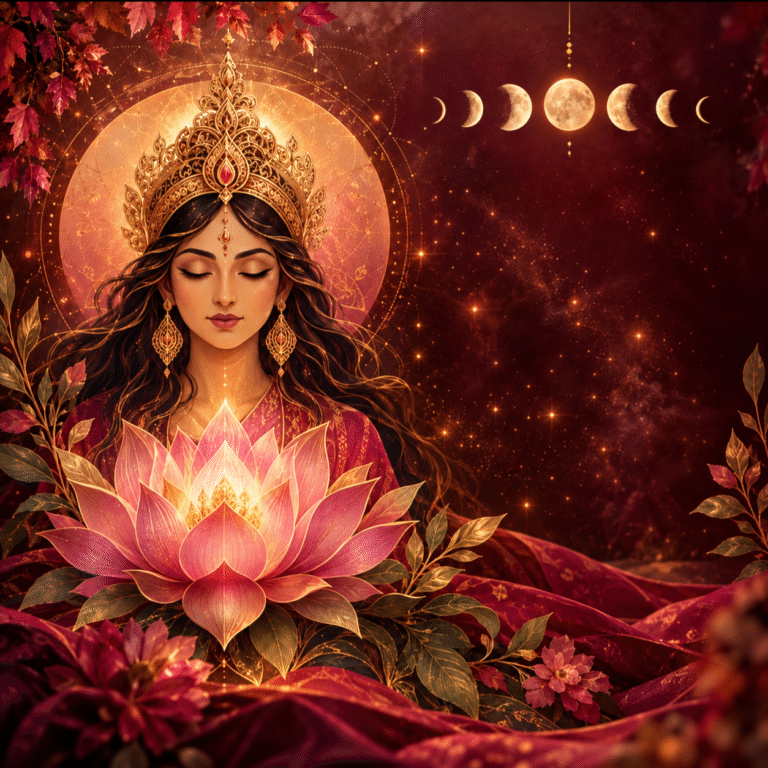
While ancestral remembrance draws our awareness towards the lives behind us, Navaratri turns our attention towards the sacred power alive within and throughout creation. Navaratri means ‘nine nights’ and is a celebration of the Divine Mother in her many forms. In many traditions, each night honours one of the nine manifestations of Durga, collectively known as the Navadurga, revealing different expressions of courage, wisdom, devotion, protection and spiritual transformation.
Sharad Navaratri also arrives at a significant point within the natural cycle. Celebrated during the autumn season, close to the equinox, it forms part of a wider rhythm of Navaratri observances associated with seasonal change (each of the four Navaratri observances celebrated throughout the year fall close to the equinoxes and solstices – times of seasonal change). Within Vedic wisdom, these turning points are understood to hold particular spiritual potency: as the energies of the natural world shift, we are invited to purify, realign and awaken to what is seeking transformation within us. As I write, we are moving through these nine sacred nights now.
Shakti is often translated as power or energy, but it is more than force in the ordinary sense. It is the living, creative intelligence of the universe: the power through which life moves, creates, protects, nourishes, transforms and knows itself. Although spoken of as the Divine Feminine, Shakti is not confined to women. It is a sacred principle alive within all beings.
Alongside the worship of the nine forms, another traditional way of contemplating Navaratri moves through the broader energies of Durga, Lakshmi and Saraswati before culminating in Vijayadashami, the day of victory. These three expressions of the Goddess can also be understood as an inner journey.
Durga is the courage to face what diminishes life. Her fierce compassion helps us establish boundaries, meet fear and clear what obstructs truth. She reminds us that tenderness does not require passivity and that love sometimes takes the form of a wholehearted no.
Lakshmi invites us to recognise, receive and nurture what is life-giving. Her abundance is not limited to material wealth. It can be experienced as beauty, vitality, dignity, generosity, relationship and the capacity to feel supported by life. Once space has been created, we must learn what we are willing to welcome into it. Receiving can be its own spiritual practice, particularly when we have become accustomed to giving, striving or proving our worth.
Saraswati is the current of wisdom, learning, creativity and truthful expression. She brings refinement and clarity: the ability to hear the quieter voice beneath conditioning and to give that knowing a form. Through her we may ask not only, What do I know? but, Am I living in a way that honours what I know?
Together, these aspects of Shakti offer a profound map for transformation. We meet what obstructs life, nourish what is sacred and listen for the wisdom that can guide our expression. The victory celebrated at the end of Navaratri need not be imagined only as a conquest over external forces. It may also be the quieter victory of consciousness over habit, truth over fear, or inner alignment over the need to remain who we have always been.
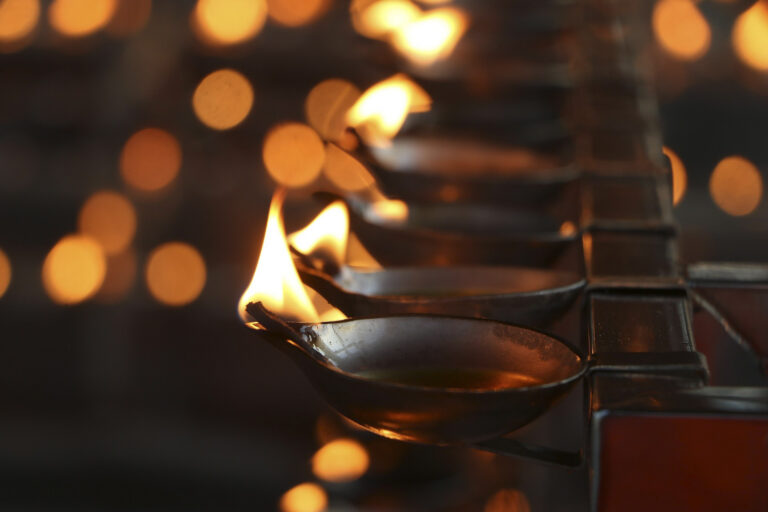
This awakening is not a movement away from darkness. Navaratri itself is observed through the night. The light of awareness is cultivated within the dark, reminding us that spiritual power is not always loud or visible. Sometimes it is the small flame we tend faithfully when the way ahead cannot yet be seen.
The Sacred Season of Descent
By October, autumn is fully present. The trees are becoming barer, the air is cooler and the hours of darkness continue to lengthen. Nature is not merely changing her appearance; she is conserving energy, drawing life beneath the surface and preparing for the stillness of winter.
Modern life rarely makes room for this kind of descent. Artificial light extends the day, constant information fills silence, and productivity culture encourages us to maintain the same output in every season. Even rest can become another task to optimise. We are rarely encouraged to move inward without first knowing what that inwardness will produce.
Nature offers a different teaching. A seed does not appear productive beneath the soil. A tree stripped of leaves may look empty. The surface gives little evidence of the work taking place within. Yet this hidden phase is essential. Energy is being conserved. Roots are being strengthened. Conditions are gathering for renewal in ways that cannot be hurried.
There are times in our lives when we too need to move closer to the roots. We may need less performance and more presence, fewer answers and more honest questions. We may need to honour tiredness, grief or uncertainty without interpreting them as failure. Not every dark night is a spiritual metaphor, and genuine emotional difficulty deserves care and support. But neither should every inward season be treated as a problem. Some forms of withdrawal are the soul’s way of restoring intimacy with itself.
Sacred descent is not disappearance. It is the willingness to travel below the surface – beneath roles, expectations and habitual identities – and encounter what is true when there is nothing left to perform.
Learning to See in the Dark
When our eyes first meet darkness, we may believe there is nothing to see. Slowly, our vision changes. Shapes emerge. Other senses awaken. We become more attentive.
The same can happen inwardly. When certainty recedes, intuition may grow clearer. When activity quietens, the body may reveal what it has been holding. When an identity loosens, a more essential self may begin to breathe beneath it.
This is why darkness can be both unsettling and deeply wise. It removes the usual reference points. It asks us to meet life without the reassurance of full visibility. We may discover that trust is not the certainty that everything will unfold as we wish. It is the capacity to stay in relationship with ourselves, with the sacred and with life while the next step is still being revealed.
We do not need to romanticise difficult seasons to recognise their teachings. Nor do we need to seek darkness when life is offering light. The wisdom lies in allowing each season to be what it is. There is a time to expand and a time to gather in; a time to speak and a time to listen; a time to bring something into the world and a time to protect what is still becoming.
October invites us to practise this deeper seeing. To sit beside a candle without asking the flame to banish the whole night. To feel the support of the ground beneath us. To remember the lives and lineages that stand behind us. To awaken the courage, nourishment and wisdom of Shakti within us. To let the dark become a place of communion rather than exile.
A Simple Practice for the Season
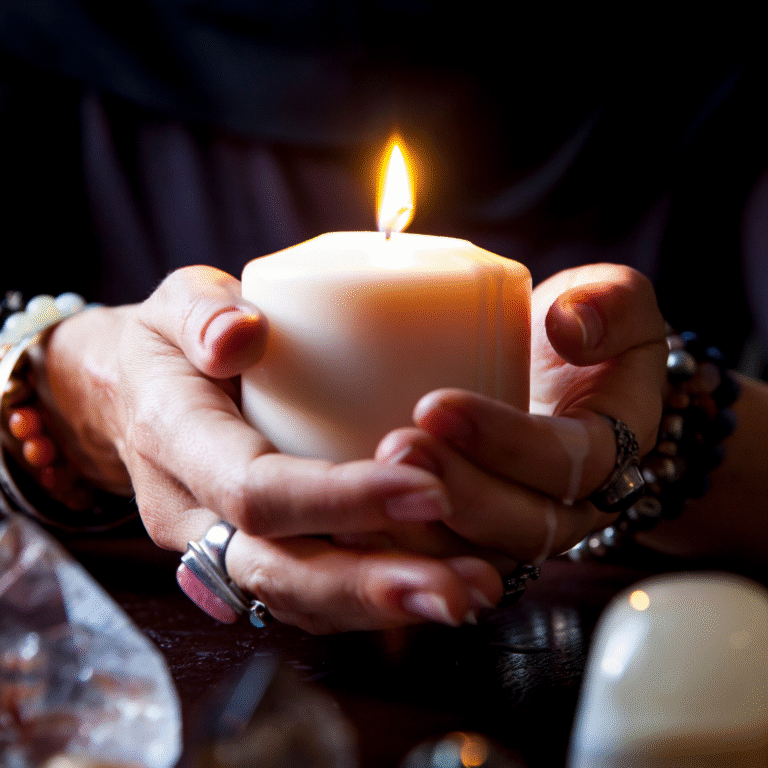
Create a quiet space and light a candle if it feels appropriate. You may wish to place beside it a photograph, flower, leaf or meaningful object. Let this be a simple act of presence rather than a performance.
Feel the weight of your body and the support beneath you. Allow your breath to settle naturally. Imagine roots extending from your body into the earth – not to hold you rigid, but to remind you that you are supported as you turn inward.
Bring to mind those who came before you, whether known by name or held only as a sense of lineage. You do not need to summon a particular feeling. Simply acknowledge: I am here because life travelled through many lives before mine.
Then turn towards your own inner flame. Ask: What strength is asking to awaken in me? What deserves to be nourished? What truth is ready to be heard?
Offer gratitude for all that has brought you to this moment. Sit for a while without trying to arrive at an answer or complete a process. Let the candle remind you that even a small light can be tended within the dark, and trust what has been stirred to continue unfolding in its own time.
The Wisdom of the Dark
The dark does not ask us to abandon the light. It teaches us where light is born.
It reminds us that beginnings are often concealed within endings; that roots deepen out of sight; that the sacred does not disappear when we cannot see the path. Through ancestral remembrance, we recognise that we belong to a story larger than our individual lives. Through Shakti, we remember the power to meet, nourish and transform that story. Through the seasonal descent, we learn that release and rest are not departures from life, but part of its rhythm.
We are shaped by what came before us, but we are not bound to repeat it. We can honour our roots while choosing how we grow.
This is autumn’s invitation: to enter the mystery with reverence, to tend the flame within, and to trust that the darkness also holds us.
Hari Om
With love and blessings, Corinne
Continue Your Journey
If this exploration of autumn’s deeper invitation has resonated with you, you may also enjoy:
Finding Steadiness in a Season of Change — an exploration of Ayurveda, seasonal transition and finding a steadier rhythm as we move into autumn.
Coming Home to Your True Nature — a reflection on healing as a journey of remembering and returning to who we are beneath the noise, conditioning and expectations of the world.
Work With Me
If something within this article has resonated with where you are in your own journey, I offer a compassionate space in which you can slow down, reconnect with yourself and receive support for your mind, body and emotional wellbeing.
You can work with me through individual holistic therapy sessions or a more supported wellbeing journey, with each experience shaped around your personal needs and intentions.
Whether you are navigating stress, anxiety, life transition, emotional overwhelm or simply feel called to return to a deeper relationship with yourself, you are warmly invited to explore the ways we can work together.
Explore ways to work with me or get in touch to arrange a complimentary clarity call.